
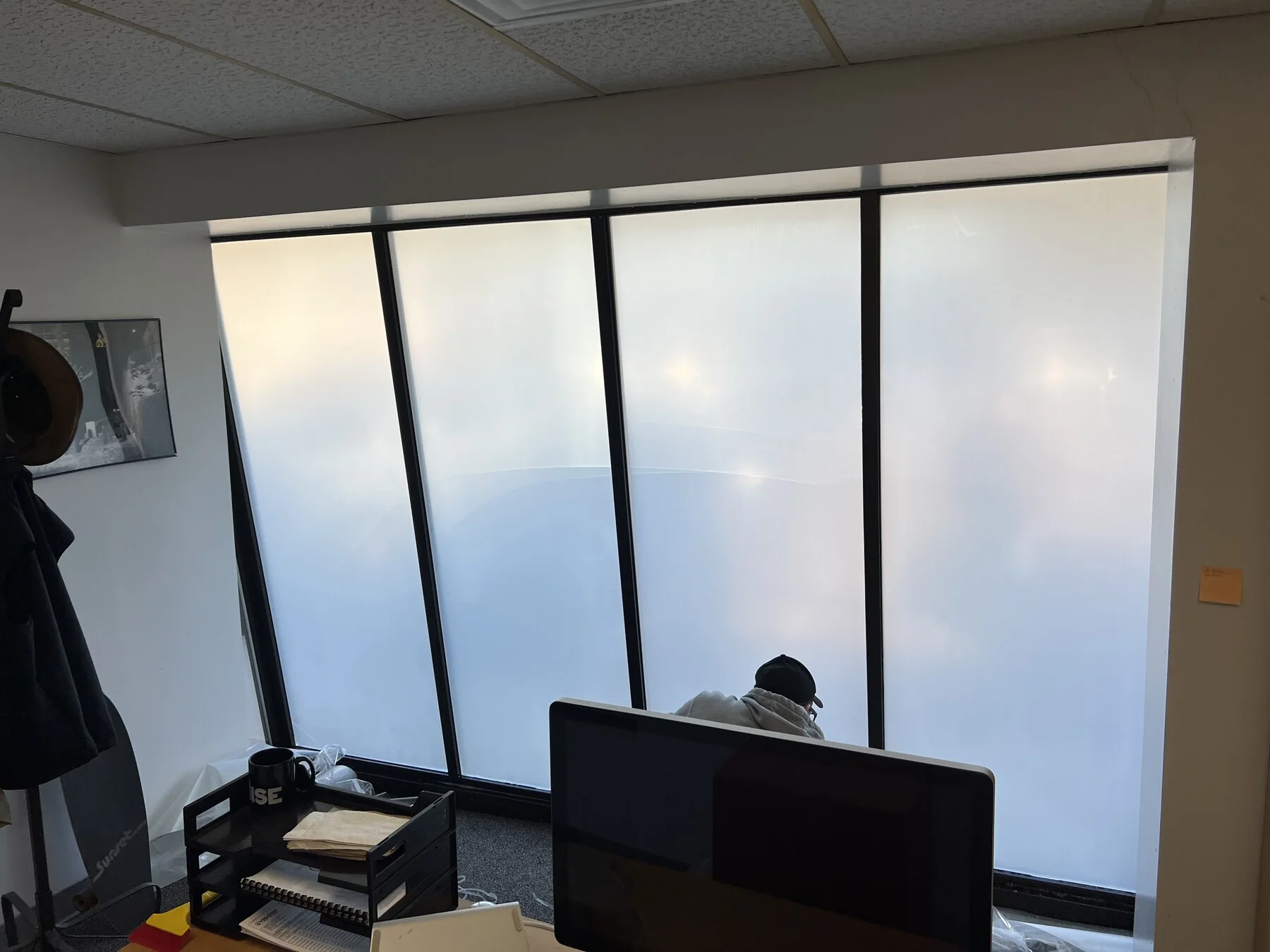
Does Privacy Window Film Work at Night?
Standard reflective one-way window film is not reliable nighttime privacy when a lit room is brighter than outdoors. For privacy after dark, consider an appropriate obscuring film or combine view-preserving solar film with blinds or shades.
November 13, 2026 · 7 min read
Why one-way privacy changes after sunset
Reflective privacy depends on the balance of light on the two sides of the glass. In bright daylight, reflections on the outside can make it harder for a passerby to see into a comparatively darker room. When outdoor light falls and indoor lights remain on, that balance changes and the room may become visible.
The effect is not an on/off switch at a fixed time. Cloud cover, shaded windows, nearby lights, viewing angle, and the brightness of the room all matter. A sample that looks private at noon is not enough evidence for a room used after dark.
- Daytime reflective privacy: depends on exterior light being stronger.
- Nighttime privacy with a clear view: plan on an additional covering.
- Privacy without a clear view: assess an obscuring or opaque film.
- Sensitive rooms: test the actual sample under the lighting you will use.
Frosted film trades a clear view for obscurity
Frosted and matte films scatter or obscure the view rather than relying only on a mirror-like reflection. They can admit light while limiting detail through the glass, which makes them useful candidates for interior office partitions or windows where outward views are less important.
Frosted does not automatically mean complete concealment. Depending on the pattern, lighting, and distance from the glass, silhouettes or movement may remain visible. For a bathroom, changing space, or confidential meeting room, evaluate a sample with someone close to the glass and with the room lights on.
Opaque film and shades solve different needs
Opaque or blackout film can block the view, but it also sacrifices the daylight and outward view through the covered area. The exact product still has to suit the glass and installation position; an interior decorative film should not be assumed suitable for every exterior window.
If you want an open daytime view and privacy after dark, compatible solar-control film paired with blinds, curtains, or shades is often the clearer choice. Film addresses the daytime solar problem; the covering supplies privacy when needed. For partial decorative coverage, remember that any clear strip remains a potential sightline.
Nighttime views are not the same as nighttime privacy
A film described as offering better nighttime views may reduce distracting interior reflections so occupants can see out more comfortably. That is a different promise from stopping someone outside from seeing in. For example, 3M describes its Night Vision series in terms of low interior reflectivity and enhanced outward views at night, not guaranteed nighttime concealment.
Ask two separate questions: can I see out, and can people see in under my actual lighting conditions? Labels such as reflective, dual-reflective, or night vision do not replace a room-specific privacy assessment.
- Heat rejection does not prove nighttime privacy.
- UV reduction does not prove visual concealment.
- A darker shade is not a guarantee that a lit interior cannot be seen.
- Obscuring film is not automatically a safety or security film.
Plan for Minnesota winter evenings and real sightlines
A home office or street-facing living room used on dark winter evenings needs a different privacy plan from a room used only in daylight. In the Waite Park and St. Cloud area, consider the times you occupy the room, where you turn on lamps, and whether sidewalks or neighboring windows look directly into the space.
For an office, map the views into desks, meeting rooms, and display areas from the hallway as well as from outside. A decorative band may screen seated occupants but leave standing sightlines open. Write down what must be hidden before choosing the design.
Check the glass before choosing the film
Privacy is only one part of the specification. Glass construction, existing coatings, insulating units, seal condition, and manufacturer restrictions can affect suitability. Product placement matters too: a film made for interior partitions may not be the correct product for sun-exposed exterior glazing.
Bring photos, approximate pane sizes, the room's use, when privacy is needed, and any window documentation to the consultation. Ask to compare samples for daylight, outward view, appearance, and nighttime obscurity—not only darkness. Do not use film to conceal a damaged pane that needs repair.
- Identify which panes and sightlines need treatment.
- Decide whether retaining the outward view is essential.
- Test with room lights on and someone near the glass.
- Review glass compatibility and product-specific warranty conditions.
Get a privacy plan, not just a darker window
Executive Film serves homes and commercial properties from its single shop at 810 Sundial Dr, Waite Park, MN 56387. Tell us whether your priority is daytime comfort, after-dark privacy, decorative screening, or a combination so we can discuss a suitable film and any additional covering needed.
Call (320) 774-3733 or request a free estimate. A useful recommendation should be clear about what the chosen treatment hides, when it works, and what view or daylight you give up.